
家庭光伏储能系统如何工作?从白天发电到夜间用电How home solar storage works: from daytime generation to evening use
看懂光伏组件、储能电池与混合逆变器如何配合,再从容量、功率和备电需求出发,规划适合家庭的能源方案。
Understand how panels, batteries and a hybrid inverter work together, then plan around energy capacity, power and backup needs.
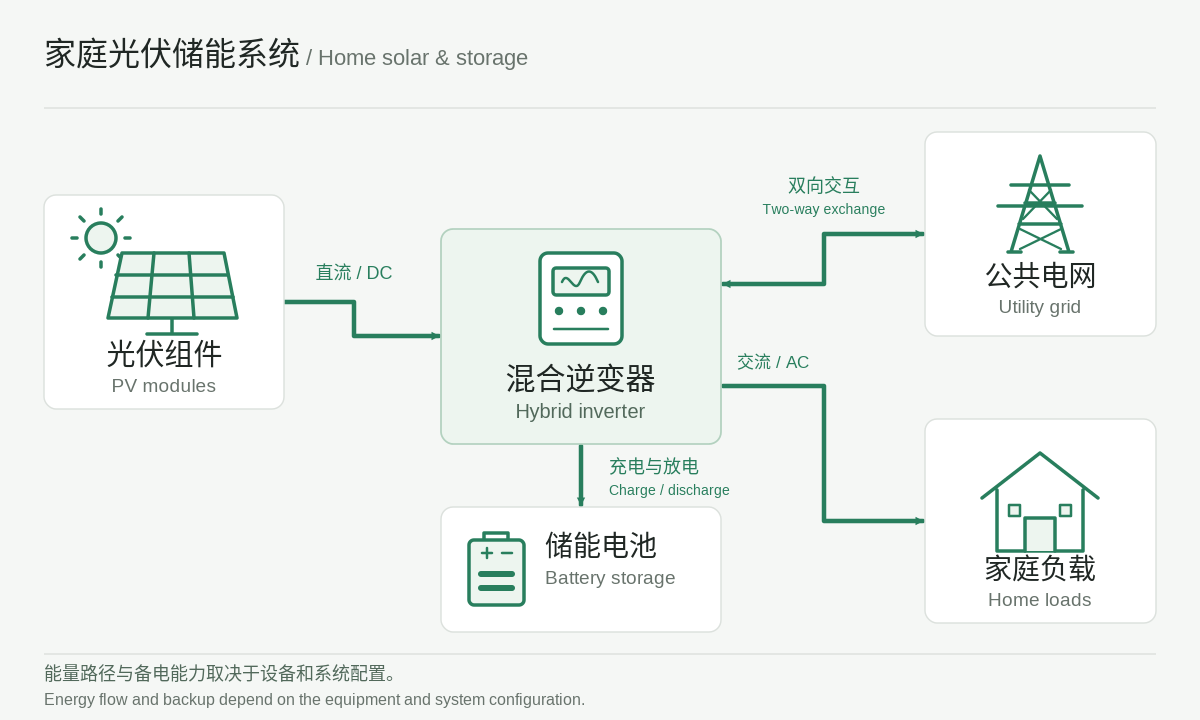
光伏组件发电,逆变器协调能量流向
光伏组件在日照下产生直流电,家用电器通常使用交流电。以混合逆变器方案为例,逆变器连接光伏、电池与家庭负载,承担电能转换,并依据设备功能和设定策略协调供电与充放电。电池负责储存能量,不会持续产生新的电量;已有光伏系统也可能采用独立设备配合的交流耦合方案。
白天:先满足用电,再按配置储存余电
采用自发自用策略时,系统可优先用光伏电量满足当时的家庭负载。当发电超过用电需求,且电池的电量、温度和充电限制允许时,余电可按配置存入电池。是否向电网输出、保留多少电量或允许电网充电,应结合当地接入规则及设备设置确认。阴影和天气变化也会影响实时发电。
夜间:电池补充,电网承担不足部分
日照减弱或停止后,电池可以在设定的放电范围内,经逆变器向负载供电。对连接电网的方案,若储存电量不足、负载功率超出允许输出,或系统需要保留备用电量,通常仍需电网补充。连续阴天和较长用电时间会改变能量平衡,因此应同时观察发电时段与家庭用电习惯。
容量 kWh 与功率 kW,回答不同问题
kWh 表示储存的能量,kW 表示某一时刻的用电或输出功率。容量较大,不代表能同时带动更多大功率电器。粗略估算供电时间时,可用可用电量除以平均负载功率,但还要计入转换损耗、允许放电范围和负载变化;标称容量不能直接当作实际可供家庭使用的全部电量。
并网自用与停电备电,需要分别确认
有光伏和电池,不等于停电后全屋仍能自动不断电。能否备电取决于逆变器的备用供电能力、与电网隔离及切换设计、实际接线和选定的备用负载,还需核对允许功率与设备启动需求。应明确哪些回路获得支持,并按相应型号说明书确认切换表现,不把并网运行能力等同于备电能力。
选型从需求出发,安装以正式资料为准
咨询时可准备日常用电记录、希望供电的设备清单、现有光伏及逆变器型号,以及安装位置。再逐项核对电池电压范围、BMS 通讯与兼容性、充放电电流、并联限制和现场温度、防护及空间条件。最终配置、保护装置和调试安装,应由专业人员依据正式设备说明书与当地要求确认。
Panels generate; the inverter coordinates
Panels generate DC electricity; most household appliances use AC. In a hybrid-inverter arrangement, the inverter converts power and coordinates PV, storage and loads according to its capabilities and settings. Batteries store energy rather than generate it. Other systems may use separate AC-coupled equipment.
Daytime: use solar and store available surplus
With a self-consumption strategy, solar can serve simultaneous household demand. Surplus may charge the battery when operating limits permit. Export, reserve and grid-charging options depend on local connection rules and system settings. Weather and shading affect available generation.
Evening: use stored energy and grid support
Later, the battery can supply loads within its permitted discharge range. A grid-connected home may still import electricity when energy or output power is insufficient, or when a reserve must be maintained. Consider consumption timing as well as daily totals.
Energy capacity and power are different
kWh measures stored energy; kW measures the rate of use or output. More capacity does not automatically allow more high-power appliances. Usable energy divided by average load gives only a rough duration estimate, subject to losses, discharge limits and changing demand.
Grid-connected operation is not automatically backup
Solar plus a battery does not guarantee uninterrupted whole-home power. Backup requires suitable inverter functions, isolation and switching, correct wiring and selected loads within system limits. Confirm supported circuits and transfer behaviour in the equipment manual.
Select for the application and follow equipment documentation
Prepare consumption records, intended loads, existing equipment models and installation details. Check voltage, BMS compatibility, current and parallel limits, and environmental requirements. Qualified personnel should confirm configuration, protection and installation using official manuals and local requirements.